
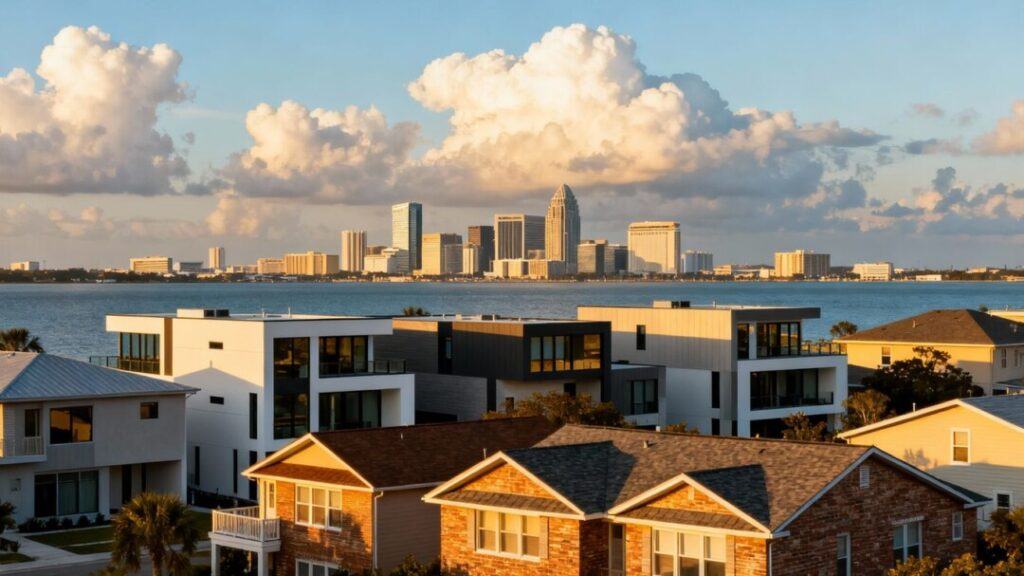
If you’ve been watching the Tampa Bay real estate market lately, you may have noticed a headline getting a lot of attention: home prices in the Tampa-St. Petersburg-Clearwater area are falling faster than in most major U.S. markets.
According to Realtor.com’s September 2026 housing data, the median listing price across the Tampa-St. Petersburg-Clearwater metro was $385,398, down 6.6% from a year earlier. Price per square foot was down 6% year over year, which was the second-largest decline among the 50 largest U.S. metropolitan areas, behind only Austin.
That sounds dramatic, but there is a little more to the story.
Prices Are Down, But So Is Inventory
One of the more interesting parts of Tampa Bay’s current market is that prices are declining at the same time the number of homes available is also declining.
Active listings across the metro were down 3.8% from a year earlier, while new listings were down 2.1%. At the same time, 27.5% of Tampa Bay listings received a price reduction in September.
In other words, buyers aren’t necessarily walking into a market overflowing with homes.
Instead, we’re seeing a market where sellers are becoming more willing to adjust their expectations while buyers remain cautious.
That distinction matters.
Why Are Sellers Cutting Prices?
A major factor is affordability.
Mortgage rates climbed sharply during September, moving above 7% for the first time since January 2025. Realtor.com reported that mortgage rates increased by nearly 40 basis points during the month, putting additional pressure on buyers who were already dealing with elevated home prices.
When borrowing becomes more expensive, buyers often have to rethink their budgets. A home that might have been comfortably affordable at a lower mortgage rate can suddenly look very different when the monthly payment increases.
That can lead to fewer offers, longer negotiations and, eventually, price reductions.
And Tampa Bay is seeing plenty of those reductions.
Nationally, 20.8% of listings received a price cut in September. Tampa Bay’s rate was significantly higher at 27.5%.
What Does This Mean for Buyers?
For buyers, the current market may provide something that has been difficult to find in recent years: more room to negotiate.
Price reductions are becoming more common, and sellers may have more flexibility when it comes to price, closing costs, repairs or other terms.
But lower asking prices don’t automatically make homes affordable.
A buyer still has to consider the entire monthly payment, including the mortgage, taxes, insurance, HOA fees and maintenance. In Florida, insurance costs in particular can make a significant difference in the true cost of owning a home.
So rather than simply looking for the biggest price reduction, buyers should look at the entire financial picture.
What Does This Mean for Sellers?
For sellers, the message is a little different.
This isn’t necessarily a market where you can’t sell your home. It is a market where pricing strategy matters.
With more than one in four Tampa Bay listings receiving a price reduction, buyers have plenty of opportunities to compare homes. An overpriced property can sit while buyers move on to homes that appear to offer better value.
That makes accurate pricing, strong presentation and realistic expectations especially important.
The first few weeks on the market can be critical. Sellers should work with their real estate professional to look at recent comparable sales, current competition and the specific characteristics of the property rather than relying solely on what a neighbor’s house sold for months ago.
Tampa Bay Isn’t the Only Market Cooling
It’s also worth putting Tampa Bay’s numbers into perspective.
The region isn’t alone in experiencing price declines. Realtor.com reported that 37 of the country’s 50 largest metropolitan areas saw year-over-year declines in price per square foot in September. Tampa Bay’s decline was simply among the largest.
At the same time, the national housing market is experiencing its own slowdown. Higher mortgage rates are affecting buyer activity, while price reductions have reached their highest September level since 2018.
So what we’re seeing locally is part of a broader shift, not something happening in isolation.
The Bottom Line
The Tampa Bay housing market is changing.
Prices are coming down, sellers are making more adjustments and buyers have more negotiating room than they did during the hottest parts of the market. But inventory is not exploding, and affordability remains a challenge.
That means the market isn’t as simple as “prices are crashing” or “it’s a buyer’s market.”
Instead, Tampa Bay appears to be moving toward a market where pricing, negotiation and preparation matter more than ever.
For buyers, that can mean more opportunities to negotiate. For sellers, it means pricing realistically from the beginning can make a meaningful difference.
And for everyone involved in a transaction, understanding the numbers behind the headlines is important. A changing market doesn’t necessarily mean a bad market. It means the strategy may need to change along with it.